HYPERSOLIDS Polytopes & Hyperspheres
From the 3rd to the 16th dimension
They were discovered over a century ago, but almost no one has seen them. Hypersolids, objects of more than three dimensions, belong to two major families:polytopes and hyperspheres.
Polytopes and hyperspheres: two dimensional frameworks.
Polytopes are constructed from vertices (spatial coordinates) forming finite skeletons (made of vertices, edges, faces, cells...). Hyperspheres, curved objects without vertices, are defined by generating circles.
On one hand, polytopes constitute the extension of polygons and polyhedra in any dimension. The cube and the tetrahedron are 3D regular convex polytopes, while the tesseract and the pentachoron are their equivalents in 4D. Regularity constraints limit their diversity as the dimension increases.
On the other hand, hyperspheres represent the set of points at a constant distance from a center in an N-dimensional space. Although uniform, they reveal in specific dimensions topological structures called fibrations, which foliate them into nested families of lower-dimensional spheres.
These two families evolve differently face to the growth of dimensions. Symmetry exceptions of polytopes are quickly exhausted: from dimension 9 onwards, only three "fundamental" families subsist. Hyperspheres exist in any dimension, but their exceptional fibrations are strictly limited to three specific dimensions.
This document describes this dual evolution. Starting from dimension 3 to establish familiar reference points, we will cross the threshold of dimension 4 with the Tesseract and the Glome, before addressing the exceptional polytopes of dimensions 5 to 8 and the algebraic limits of dimension 16 for hyperspheres.
Polytopes
Finite structures defined by precise coordinates. In 3D: 5 Platonic solids. In 4D: 6 regular convex polychora. In N ≥ 5 dimensions: 3 fundamental regular families and the semi-regular family of demicubes.
Hyperspheres
One manifold per dimension. Three exceptional fibrations associated with division hypercomplex algebras: complex numbers (ℂ), quaternions (ℍ), and octonions (𝕆).
The Platonic solids.
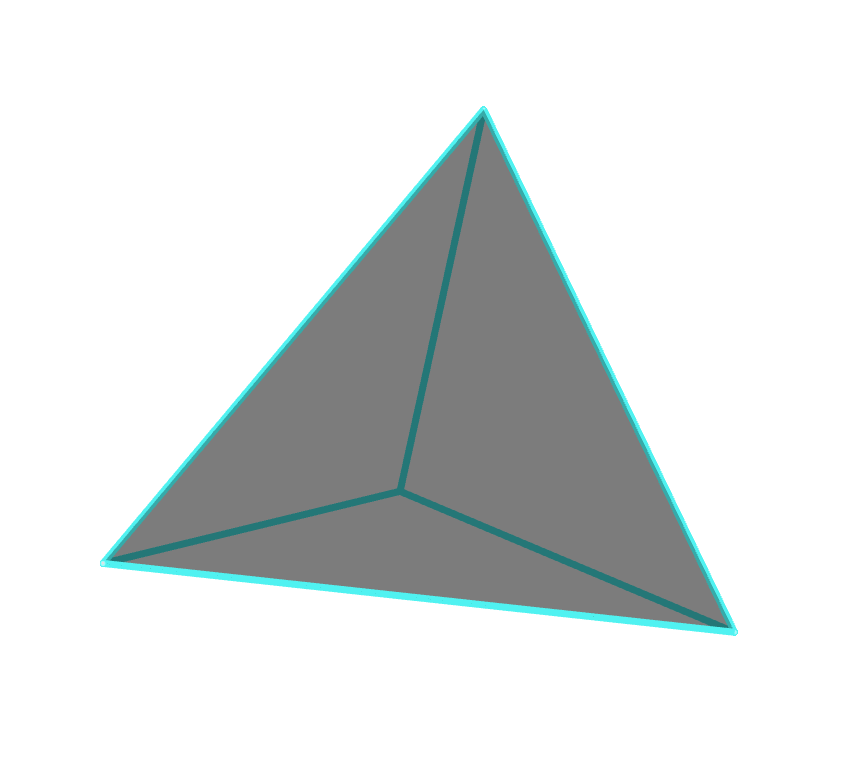
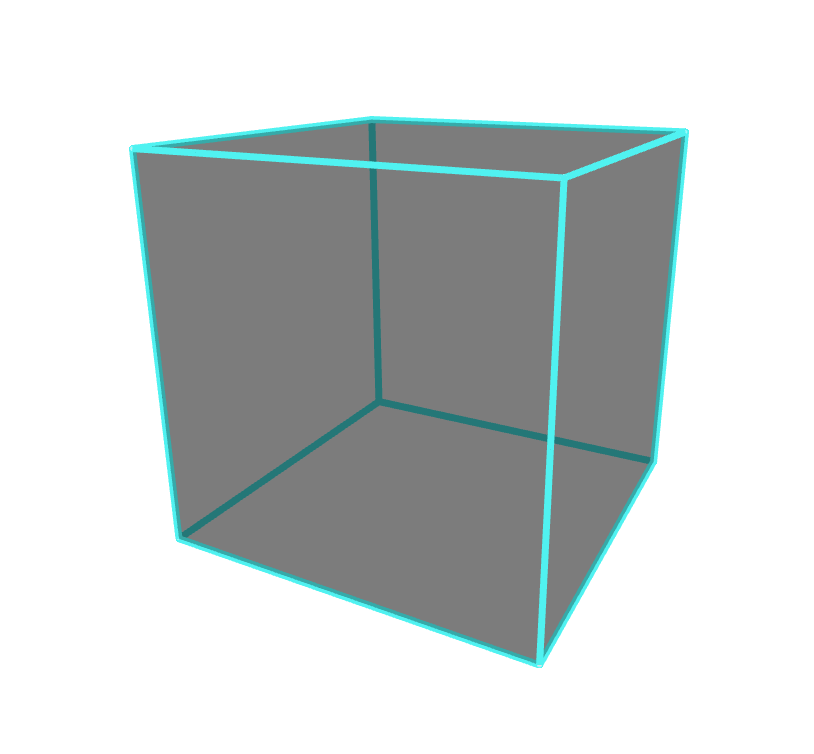
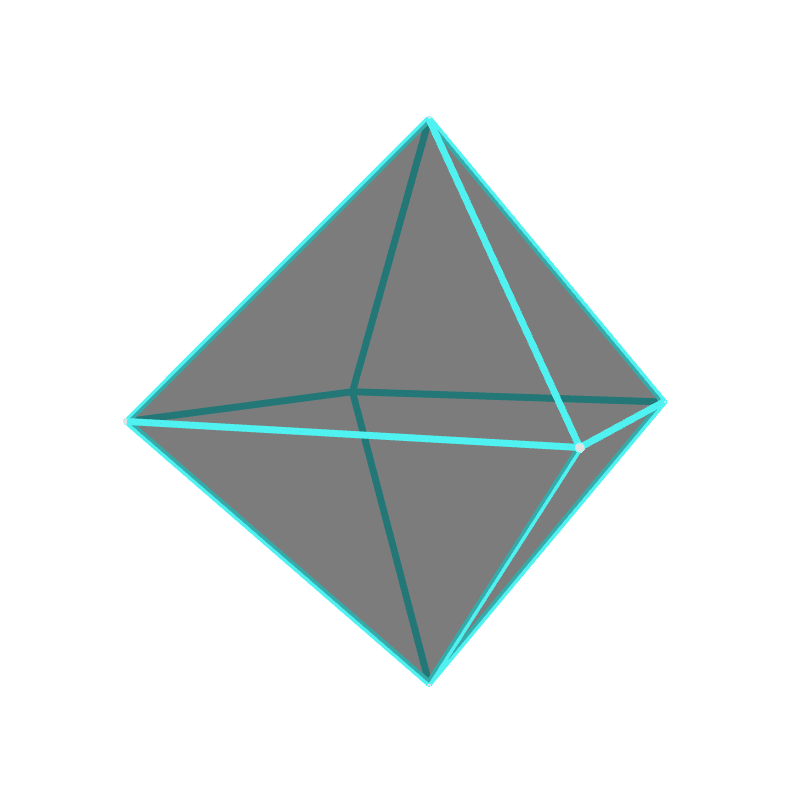
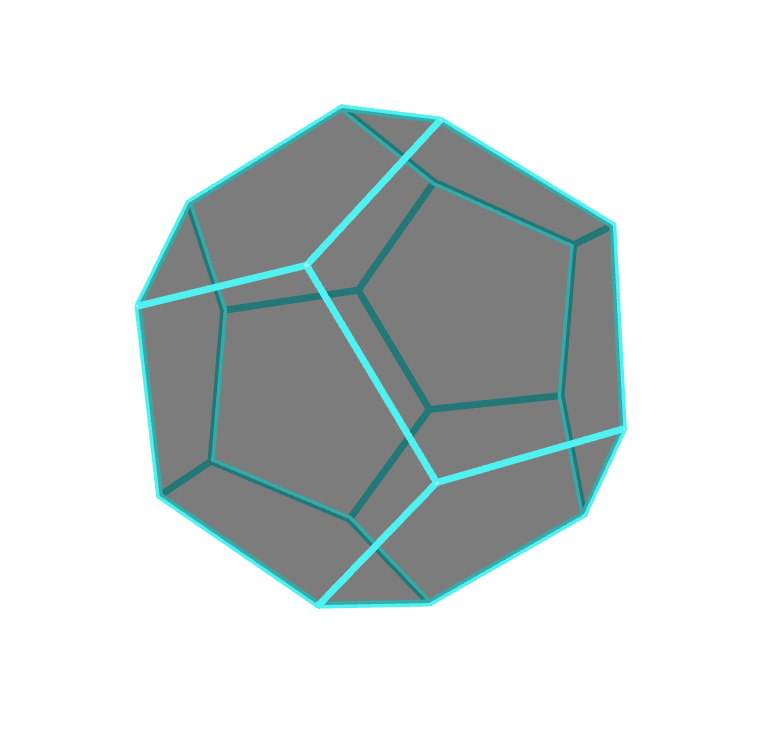
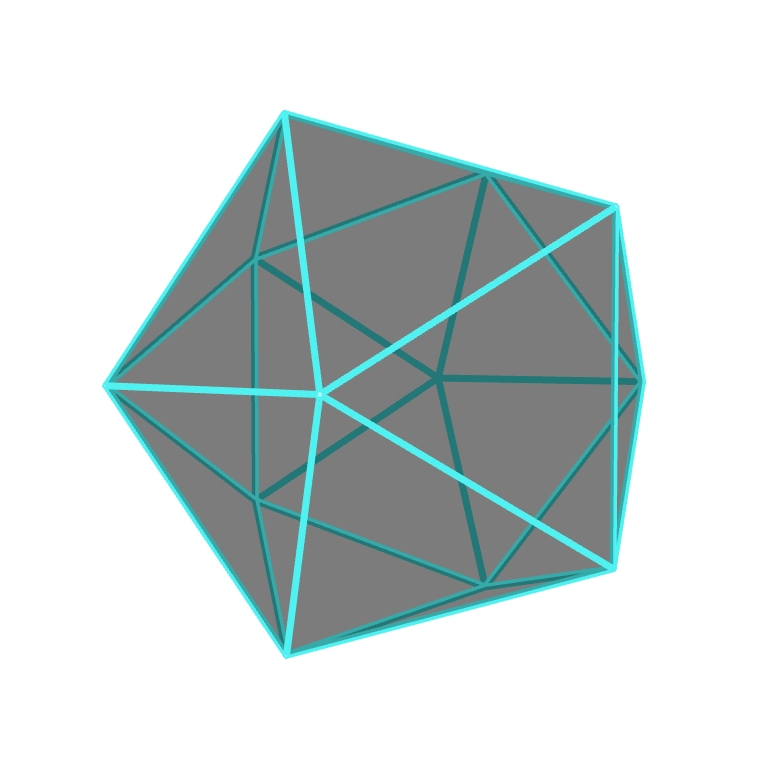
In dimension 3, there are exactly five regular convex polyhedra, called Platonic solids. The regularity constraint requires that all their faces be identical regular polygons, their vertices be equivalent, and their edges have the same length.
These five basic geometric shapes and their traditional associations are:
- Tetrahedron: Associated with fire, consisting of 4 triangular faces.
- Cube: Associated with earth, consisting of 6 square faces.
- Octahedron: Associated with air, consisting of 8 triangular faces.
- Dodecahedron: Associated with ether, consisting of 12 pentagonal faces.
- Icosahedron: Associated with water, consisting of 20 triangular faces.
Each solid has one or more analogues in higher dimensions. In dimension 4, angular constraints relax to allow six regular solutions (polychora), before tightening again from dimension 5.
The threshold of the 4th dimension Tesseract and Glome
The 4th dimension adds a degree of freedom orthogonal to the three dimensions of physical space. To visualize it, we use constructive analogies and projections.
The Tesseract
Just as a cube is obtained by connecting two squares offset in the 3rd dimension, a tesseract is drawn by connecting two cubes offset in the 4th dimension. The connecting edges are parallel to each other and orthogonal to all other edges, although the planar projection distorts angles and lengths.
The net of a tesseract consists of 8 cubic cells folded into the 4th dimension: the central cell (content), the outer cell (boundary), and the 6 intermediate cells (top, bottom, front, back, left, right) surrounding the center.
The term tesseract (meaning "4 rays") refers to the 4 orthogonal edges intersecting at each vertex. Depending on the chosen angle, its planar projection can form two nested octagons (Petrie projection) or two centered hexagons.
Coordinates: (±1, ±1, ±1, ±1)
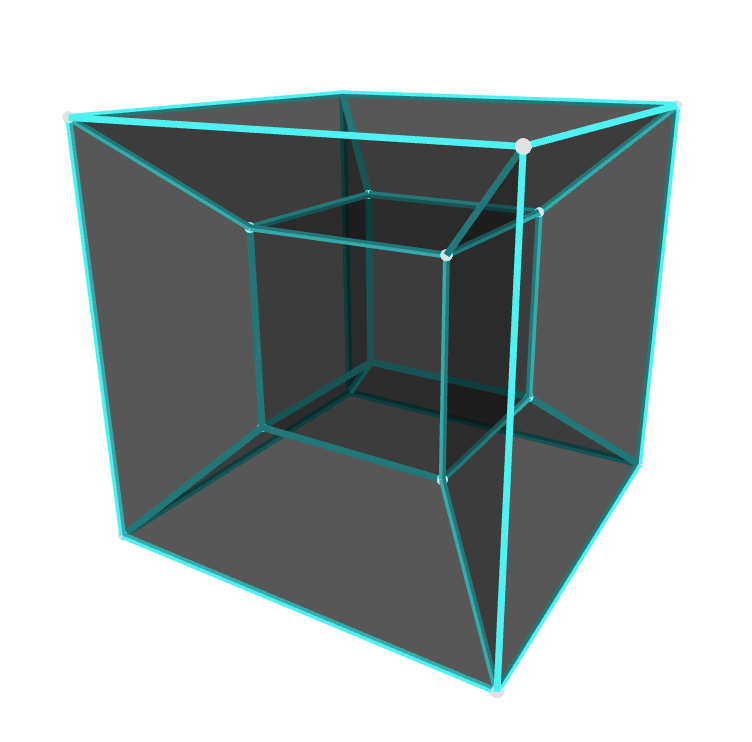 Cube-in-cube projection · 8 cells
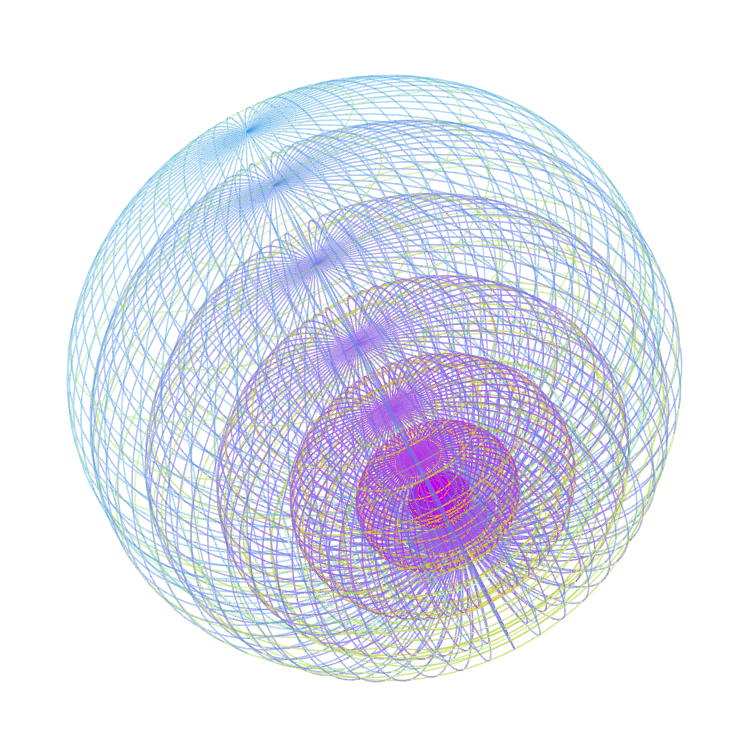 S³ · representation by stratification
The Glome
The glome (or 3-sphere) is the 4D analogue of the three-dimensional sphere. Geometrically, it is the set of points at a constant distance from the origin in ℝ⁴, forming a closed three-dimensional manifold.
Its structure can be studied using three modes of representation: the hypermeridian mesh (rotation of a sphere projecting into 3D), stratification (stacking of concentric spherical strata shrinking toward the hyperpoles), or the Hopf fibration.
On the algebraic level, the points of the glome correspond to unit quaternions (of norm 1). It possesses a non-commutative Lie group structure SU(2), which distinguishes it from the 2-sphere.
The six regular convex polychora
Dimension 4 admits exactly six regular convex polychora that generalize the Platonic solids. Their representations require 3D projections involving an unavoidable loss of information regarding angles or lengths.
Pentachoron
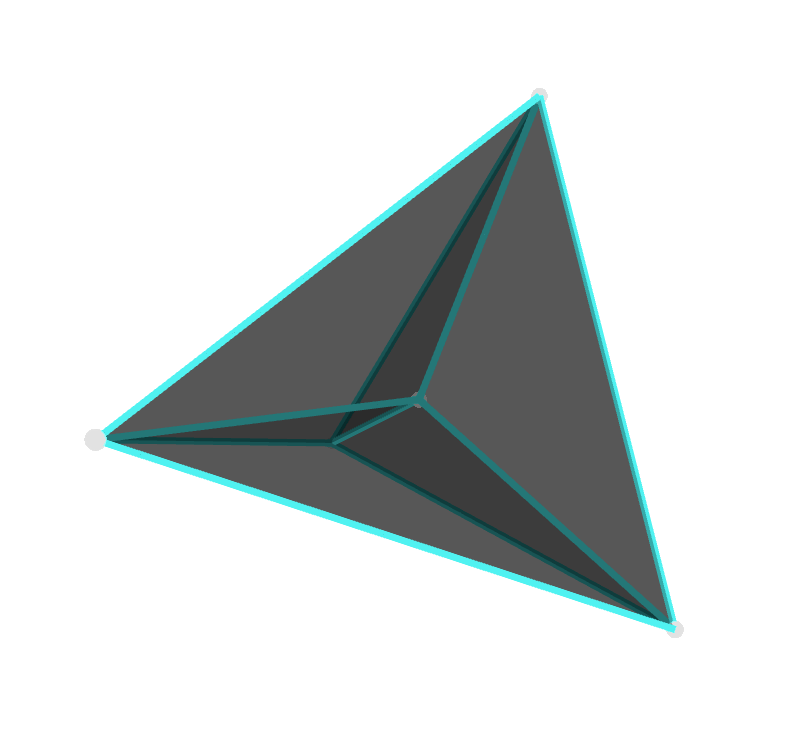
4D analogue of the tetrahedron, consisting of 5 tetrahedral cells. It is the simplest polychoron. Coordinates: 5 equidistant vertices. Its Petrie projection forms a pentagram within a pentagon.
Tesseract
4D analogue of the cube, consisting of 8 cubic cells. Orthogonal and regular construction. Coordinates: (±1, ±1, ±1, ±1). Its Petrie projection forms two interlocking octagons.
Hexadecachoron
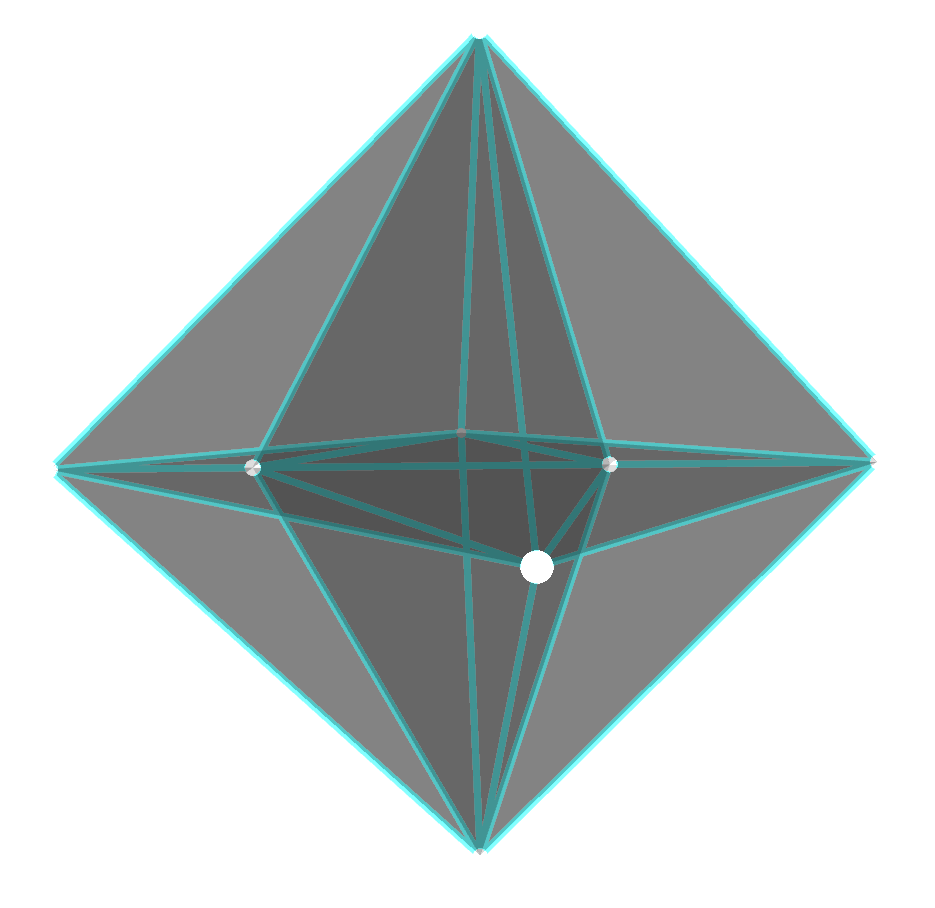
4D analogue of the octahedron, consisting of 16 tetrahedral cells. Dual of the tesseract. Coordinates: (±1, 0, 0, 0) and permutations. Its Petrie projection forms an octagon.
24-Cell
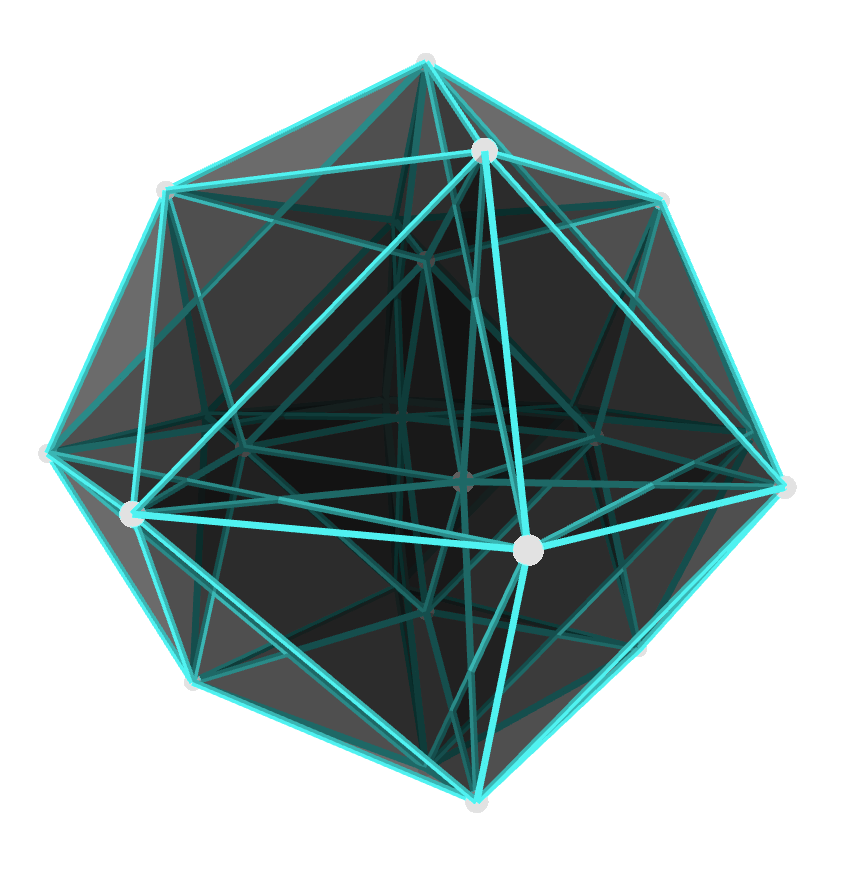
A 4D exclusivity with no three-dimensional analogue. Composed of 24 octahedral cells. Highly symmetrical coordinates: (±1, ±1, 0, 0) and permutations.
120-Cell
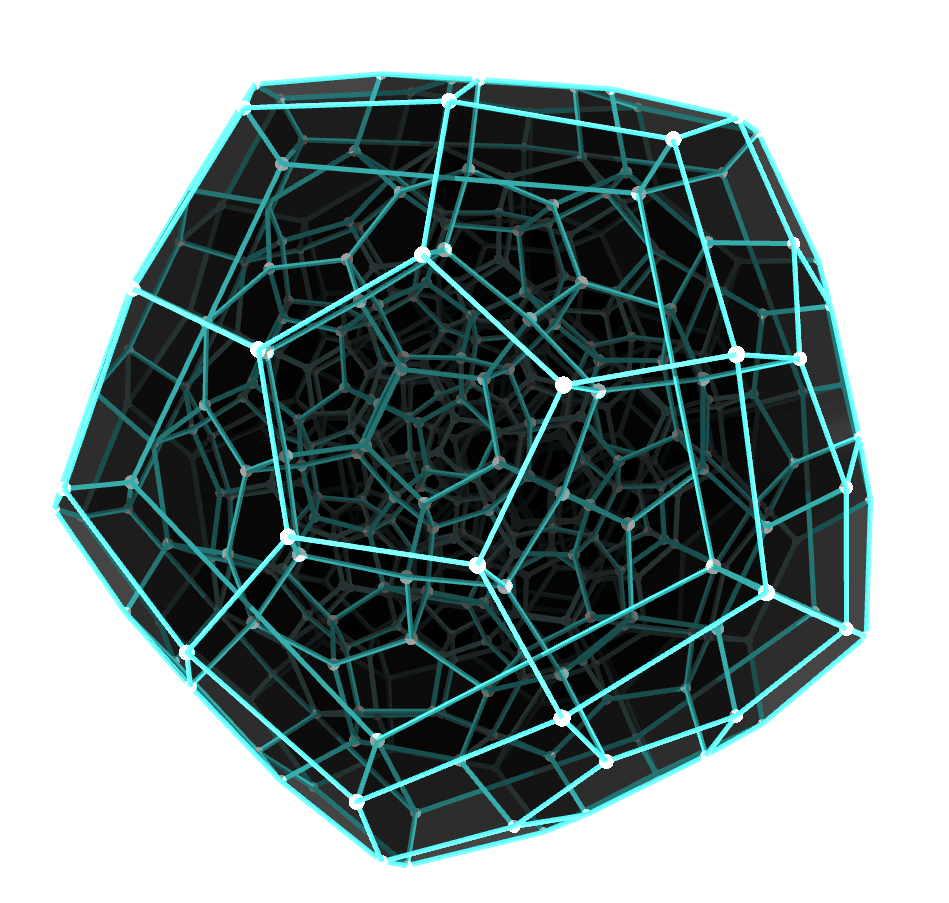
4D analogue of the dodecahedron, consisting of 120 dodecahedral cells. A gigantic structure whose proportions and vertices coordinates are governed by the golden ratio.
600-Cell
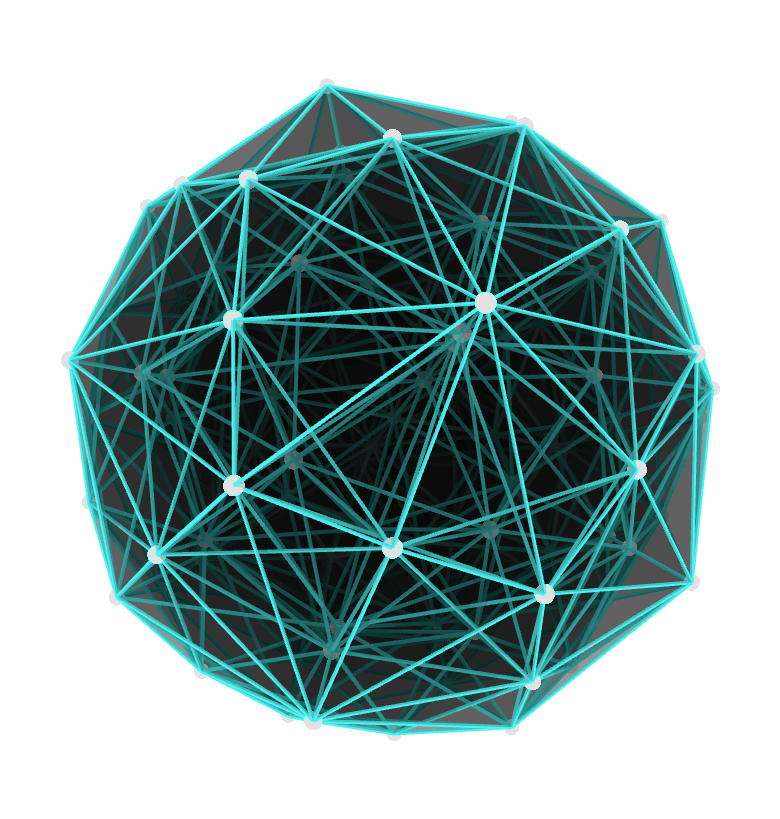
4D analogue of the icosahedron, consisting of 600 tetrahedral cells. Dual of the 120-cell, its ultra-dense structure also relies on the golden ratio.
Between 5 and 8D: Gosset polytopes
From dimension 5 onwards, spatial constraints eliminate the exceptional families H (golden ratio) and F (24-cell). Regular polytopes are limited to the three fundamental families, while an exceptional semi-regular lineage (Gosset) develops up to dimension 8.
The three fundamental families.
The most economical shape
An N-dimensional simplex has N+1 equidistant vertices in N dimensions. It generalizes the triangle (2D), tetrahedron (3D), and pentachoron (4D).
tetrahedron → pentachoron → 5-simplex → 6-simplex…
The orthogonal that tiles space
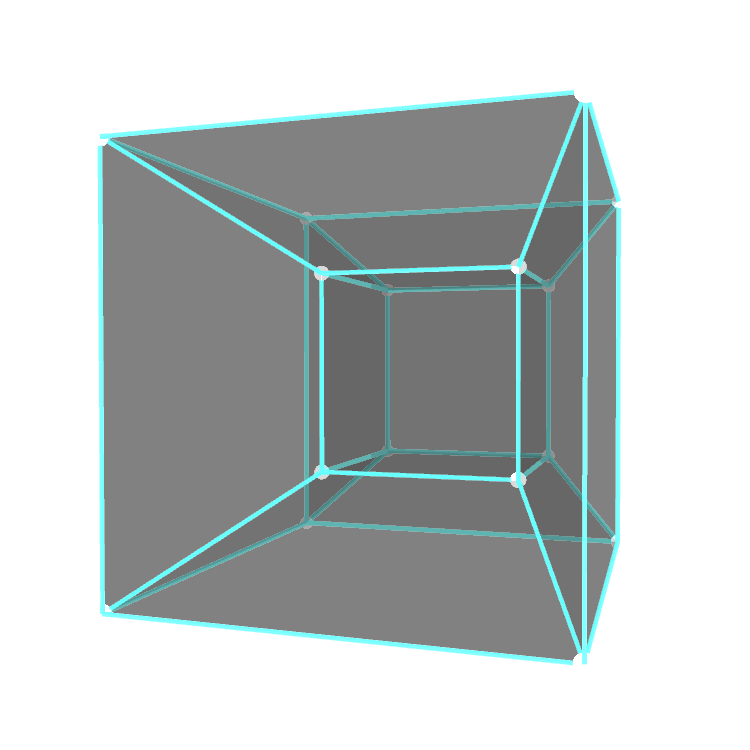
An N-dimensional hypercube has 2^N vertices. Obtained by connecting two parallel (N-1)-cubes, it has 2N facets of dimension N-1. At each vertex, all edges are orthogonal.
cube → tesseract → penteract → hexeract…
The dual of the hypercube
An orthoplex has 2N vertices placed on the coordinate axes. It is the analogue of the octahedron (3D) and hexadecachoron (4D), forming the dual of the hypercube.
octahedron → hexadecachoron → 5-orthoplex → 6-orthoplex…
The alternated symmetry
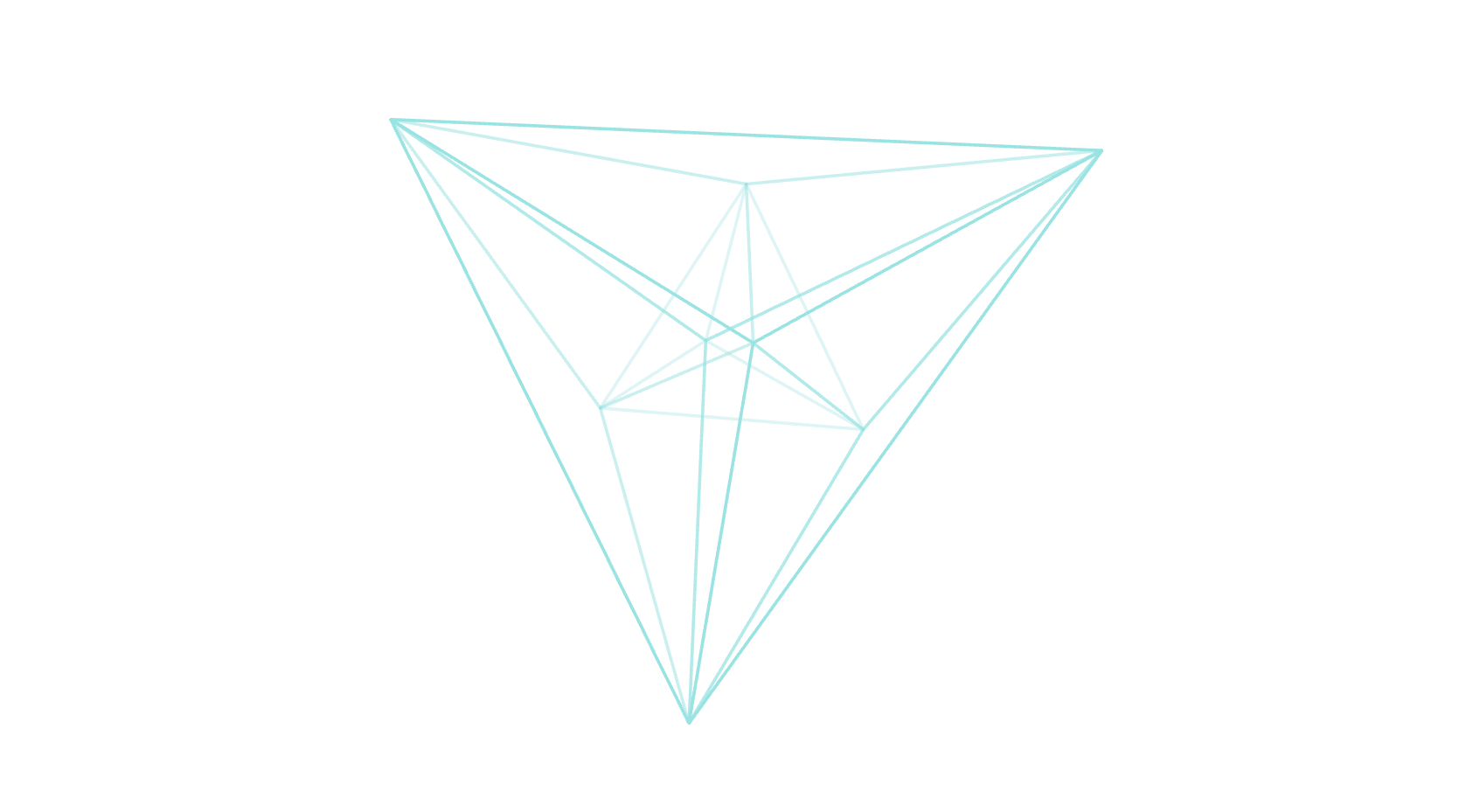
An N-dimensional demicube is an alternated half of a hypercube. It is a semi-regular polytope starting from dimension 5, defining the entry point of the Gosset lineage.
tetrahedron → hexadecachoron → demipenteract…
Demicubes and the Gosset lineage.
The family of demicubes (denoted Dn) is obtained by removing every other vertex of the hypercube of the same dimension. In dimension 3, the demicube is a tetrahedron. In dimension 4, it coincides with the hexadecachoron.
From dimension 5, the demipenteract (5D, code 121, 16 vertices) stands out. Its coordinates are of the form (±1, ±1, ±1, ±1, ±1) retaining sign combinations with an odd number of +1.
The demipenteract (5-demicube) serves as the anchoring point for Gosset's semi-regular polytopes (family k21). These polytopes structure around the E6, E7 and E8 exceptional groups in dimensions 6, 7 and 8.
Gosset's semi-regular structures assemble simplexes and demicubes, offering particularly dense space-filling and symmetry configurations.
Gosset polytopes (k21 lineage).
The Gosset family k21 increases by one degree of freedom at each dimension. It ends in dimension 8 with the exceptional polytope 421 associated with the E8 Lie group.
Demipenteract
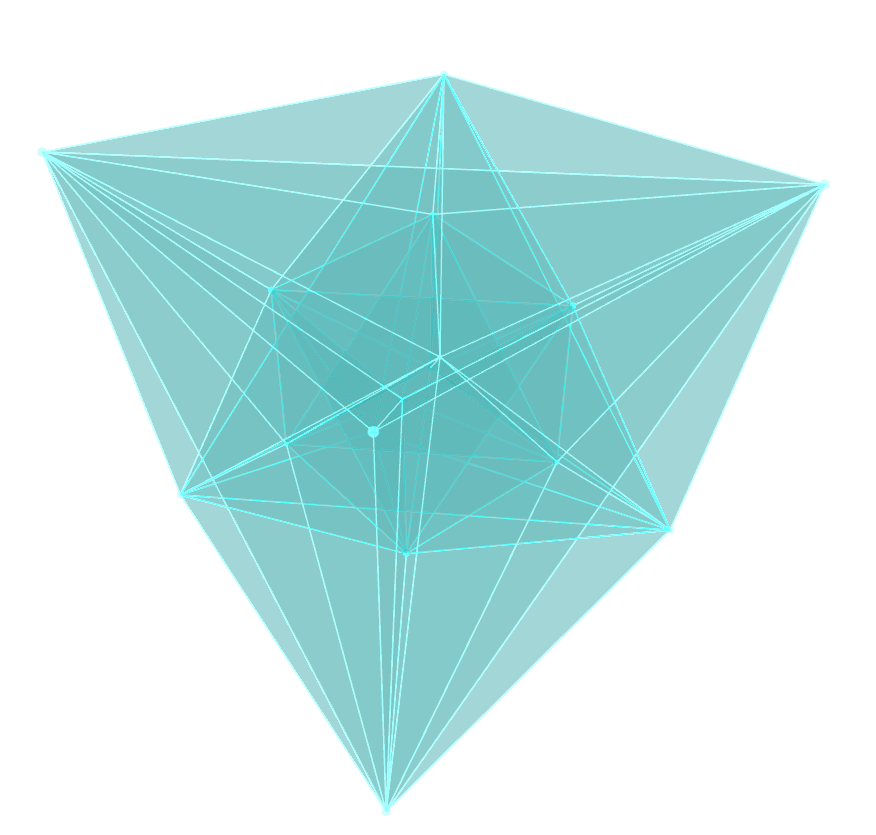
Code 121. One half of a penteract (5D cube) possessing the Gosset structural pattern. Coordinates with an odd number of +1.
Polytope 221
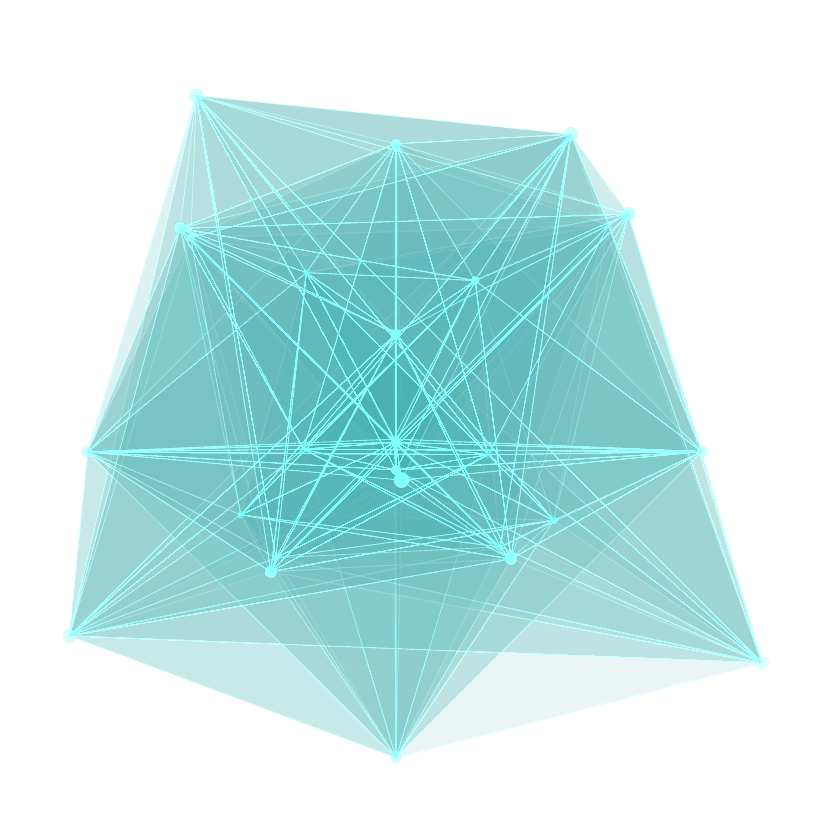
First truly exceptional Gosset structure. Composed of 1,080 tetrahedral cells for 27 vertices.
Polytope 321
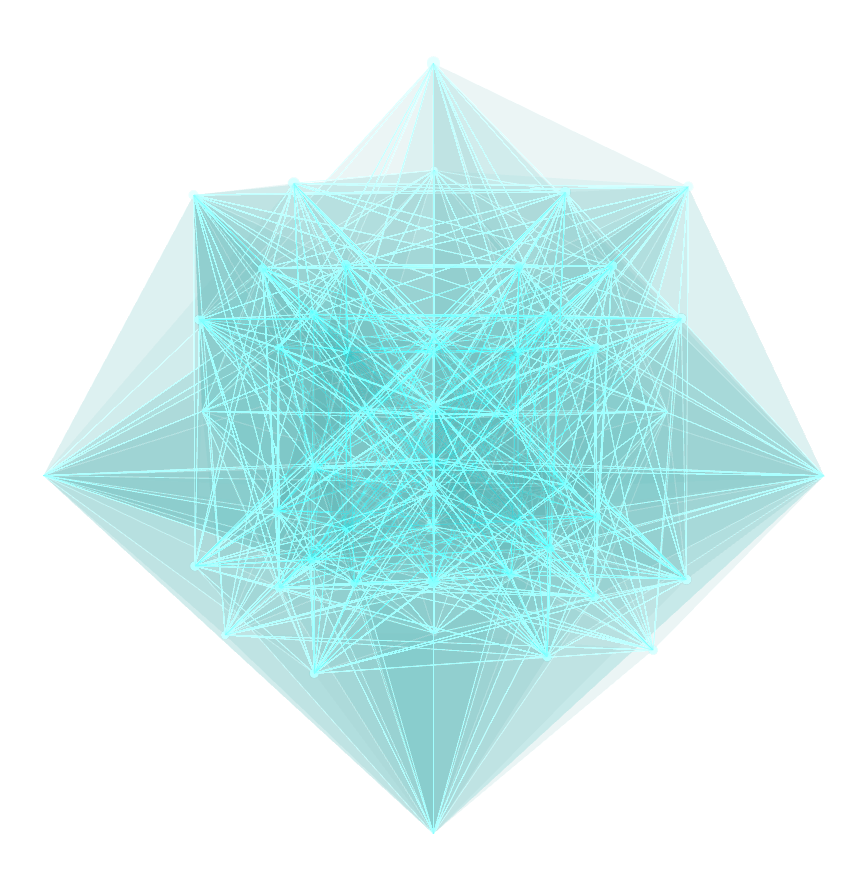
Transition step toward a more complex symmetry, comprising 56 vertices and 10,080 tetrahedral cells.
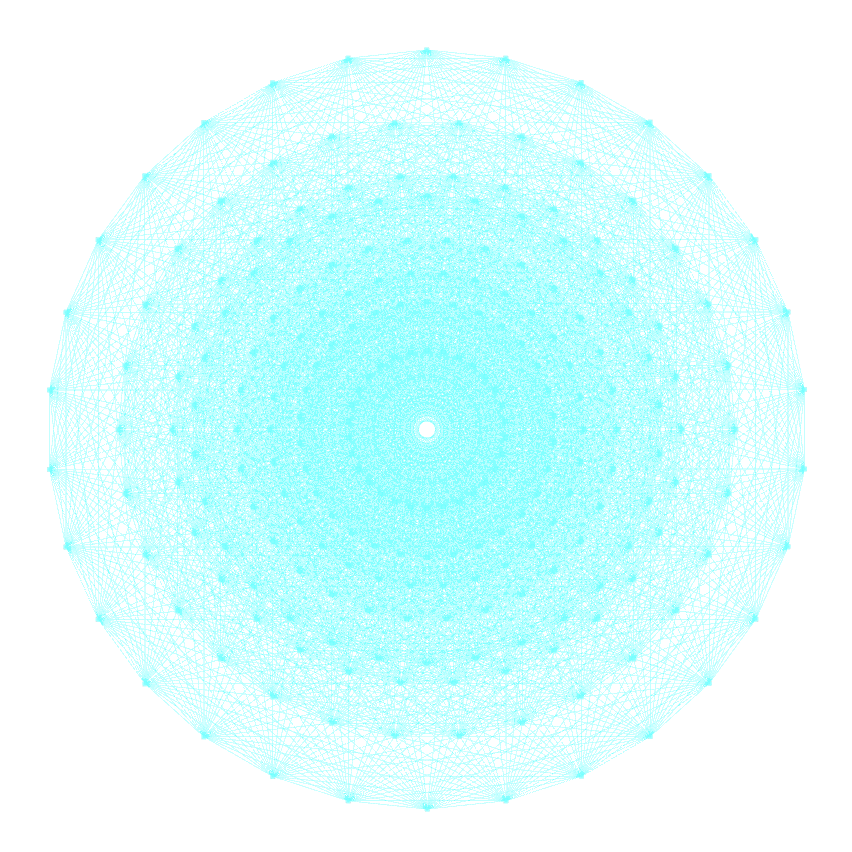 Petrie projection · E8 lattice
The polytope 421
The 421 polytope constitutes the maximal completion of the Gosset lineage in dimension 8. It has 240 vertices and contains more than 240,000 lower-dimensional cells (including many tetrahedra).
It is the last finite polytope of its lineage. Beyond (in dimension 9 and above), analogous constructions turn into infinite honeycombs (tessellations) of space.
The associated E8 vertex lattice yields the highest possible sphere packing density in dimension 8. Its 240 vertices correspond to the roots of the exceptional group E8, used by some theoretical physicists.
Hyperspheres and exceptional fibrations.
While regular polytopes vanish after dimension 8, hyperspheres (Sn) exist in all dimensions. However, their regular fibrations (Hopf fibrations) are strictly limited by division algebras.
In 3D, two distinct great circles on a sphere always intersect. But in 4D, the extra dimension allows the 3-sphere (glome) to be filled with circular fibers that wrap around each other without ever intersecting. This is the **Hopf Fibration**, mapping the 3-sphere onto a 2-sphere.
This construction relies on complex numbers (ℂ) to define regular orthogonal rotations. Similar fibrations occur in dimension 8 (using quaternions ℍ, mapping S⁷ onto S⁴) and dimension 16 (using octonions 𝕆, mapping S¹⁵ onto S⁸).
The 3-Sphere (Glome)
Projects the 3-sphere onto a 2-sphere with circular fibers. Governed by complex numbers (ℂ).
The 7-Sphere
Projects the 7-sphere onto a 4-sphere with 3-sphere fibers (glomes). Governed by quaternions (ℍ).
The 15-Sphere
Projects the 15-sphere onto an 8-sphere with 7-sphere fibers. Governed by octonions (𝕆).
The limit of the 16th dimension.
Why are there no Hopf fibrations in higher dimensions? The answer lies in Adams' theorem and the gradual loss of algebraic properties.
Theoretical limit
The octonionic fibration (defined on 𝕆) constitutes the ultimate geometric structure of this type. It projects the 15-sphere onto the 8-sphere, with the 7-sphere as fiber.
With each algebraic extension, a fundamental property is lost: complex numbers lose order, quaternions lose commutativity, and octonions surrender associativity.
Sedenions (dimension 16 algebra) lose the division property, which forbids any non-trivial spherical fibration beyond dimension 16. This is the theoretical limit of exceptional fibrations.
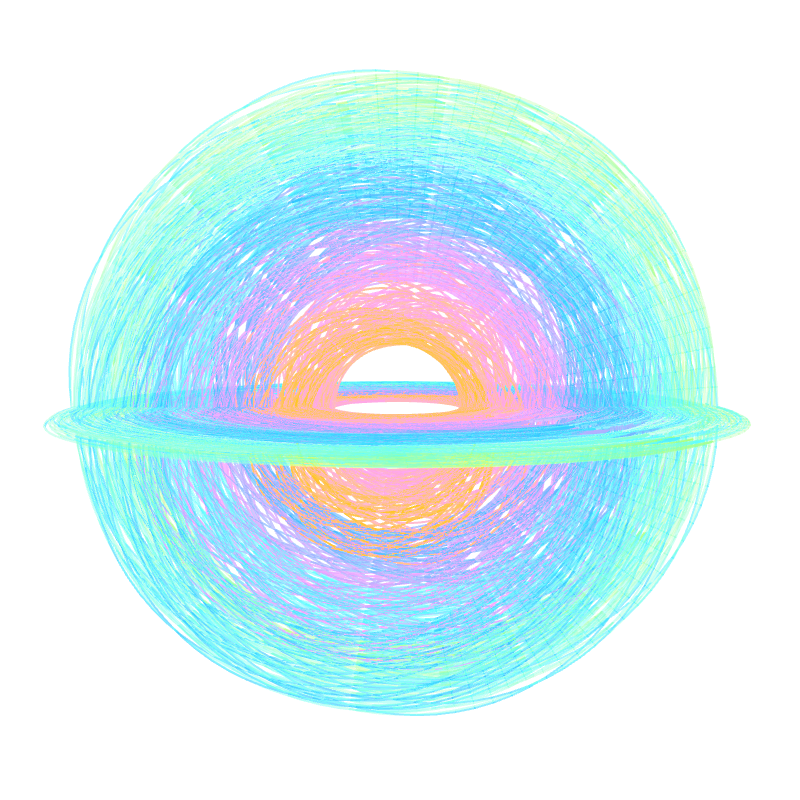 Higher Hopf fibrations
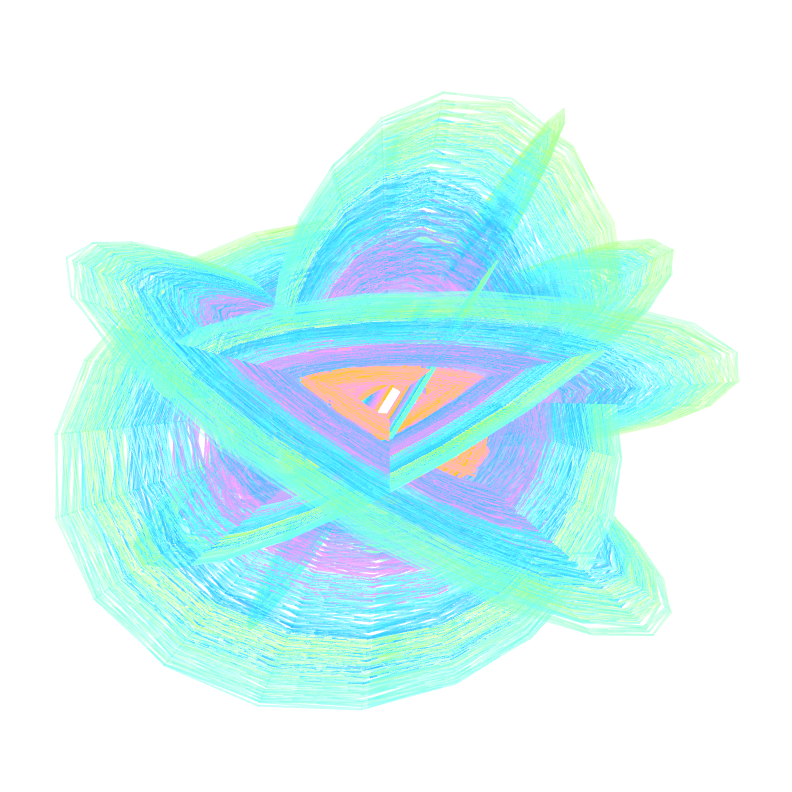 Quaternionic Hopf fibration on ℍ
The 7-sphere
The quaternionic fibration is represented by the map S3 ↪ S7 → S4.
Each point of the base (the 4-sphere) is associated with a three-dimensional fiber (an entire 3-sphere) inside the 7-sphere. It relies on the non-commutative structure of quaternions.
The 15-sphere
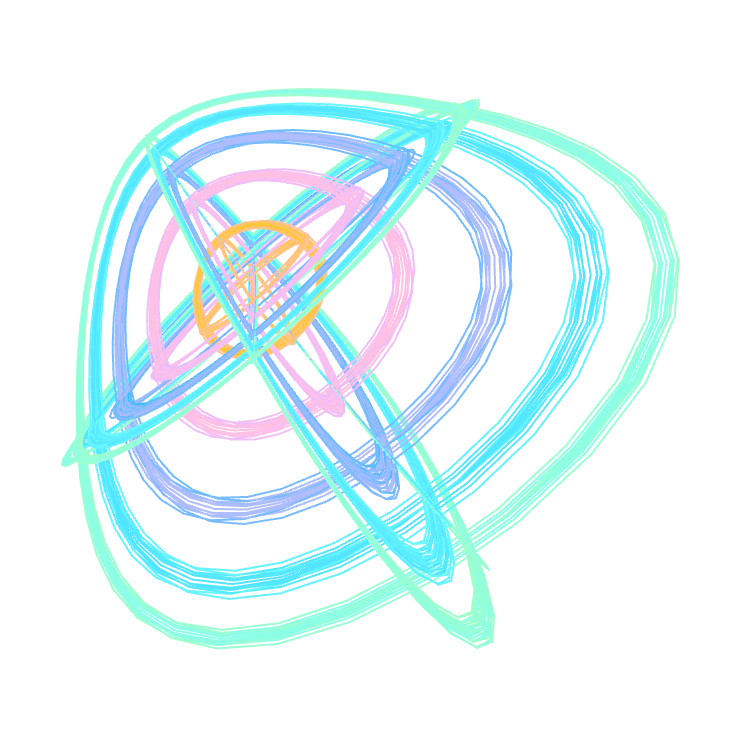
The octonionic fibration is represented by the map S7 ↪ S15 → S8.
It is made possible by the 7 imaginary units of octonions. It is the last of the regular topological fibrations of spheres, because higher-dimensional algebras lose the division property.
 Octonionic Hopf fibration on 𝕆
Comparative Atlas of Hypersolids
This table sums up how polytopes and hyperspheres evolve in higher dimensions.
| Dimension | Polytopes (Discrete skeletons) | Hyperspheres (Continuous manifolds) | Associated Algebra |
|---|---|---|---|
| 3D | 5 regular solids (Platonic) Tetrahedron · Cube · Octahedron · Dodecahedron · Icosahedron. | 2-sphere (S²) No non-trivial topological fibration. | ℝ (Reals) |
| 4D | 6 polychora (A₄, B₄, F₄, H₄) Pentachoron · Tesseract · Hexadecachoron · 24-Cell · 120- & 600-Cell. | 3-sphere (Glome, Hopf fibration) S¹ ↪ S³ → S². Simple linked circular fibers. | ℂ (Complexes) |
| 5–8D | 3 families + demicubes + Gosset Aₙ, Bₙ, Bₙ*, Dₙ + Gosset polytopes (2₂₁, 3₂₁, 4₂₁). | 7-sphere (quaternionic fibration) S³ ↪ S⁷ → S⁴. Fibers made of entire 3-spheres. | ℍ (Quaternions) |
| 9–16D | 4 infinite families Aₙ, Bₙ, Bₙ*, Dₙ. No more exceptional polytopes. | 15-sphere (octonionic fibration) S⁷ ↪ S¹⁵ → S⁸. Ultimate possible topological fibration. | 𝕆 (Octonions) |
| > 16D | 4 infinite families Aₙ, Bₙ, Bₙ*, Dₙ. No exceptional configurations. | Standard N-spheres No fibrations (loss of division property). | Sedenions and beyond |